

The wisdom of resistance


Weerstand is geen blokkade, maar informatie. In deze blog onderzoekt Franka Juta hoe je als veranderaar de signalen van weerstand herkent en benut. Van subtiele sabotage tot stilzwijgende teams: elk gedrag vertelt iets over de onderstroom. Ontdek hoe je met inzicht, empathie en structuur verandering laat landen in de praktijk van alledag.


The 'no' isn't the problem, but your reflex to brush it aside might be.
From plan to friction in 10 seconds
You know the drill: you’re standing in front of a team, full of optimism, ready to pitch your plan. A new process, a fresh approach, a fun session. You’re thinking: yes, this is going to be great! They’re thinking: meh... What do you get back? Shuffling feet, rolling eyes, and a sigh to top it all off. You’re hoping for buy-in, but you get awkwardness instead. And you? You’re left wondering: What am I missing?
Been there. Early in my career, I used to try and push through as fast as possible. Just step right over that resistance. Stop complaining, just get it done. But that is exactly what you shouldn't do. Resistance isn't a problem. It's data. It’s the crack between your plan and the company culture.
Why should you or I care about this?
In this second blog of the series 'change starts with culture,' we’re diving into the wonderful world of resistance. For years, it’s been said that around 70% of major change initiatives fail (pollackpeacebuilding.com). Often, the cause isn't the strategy on paper, but human behavior and organizational culture.
An unhealthy or rigid culture turns out to be a massive hurdle. In an international study by Capgemini, 63% of respondents cited the existing company culture as the biggest obstacle to digital transformation.
Beyond my own personal discomfort, the numbers show that it’s definitely worth getting to the bottom of this.
What you’ll learn in this blog
- How to spot resistance using the sabotage line
- What the underlying patterns of resistance are
- How to work with it effectively as a change agent
Resistance as a signpost
Be honest; have you ever said or thought the things below? I know I have. ;)
- They’re just being difficult for the sake of it.
- They’re just anti-change.
- They’re always so negative
But these days, I ask myself very different questions:
- Did I push too hard?
- Was I moving too fast?
- Was I curious about the ‘no’?
- Did I actually listen well?
I was often too fast. Or I pushed too hard. And yeah, that’s when you get resistance. Resistance is rarely comfortable. But it did force me to look at my own behavior. And guess what? That was the key. No magic 5-step model, unfortunately. But it is a powerful insight: the undercurrent never lies. And it shows itself through behavior.
But how do you spot that resistance early on? What are the first signs, the first behaviors?
The sabotage line from Deep Democracy offers a great tool for that.
The sabotage line: how the undercurrent reveals itself
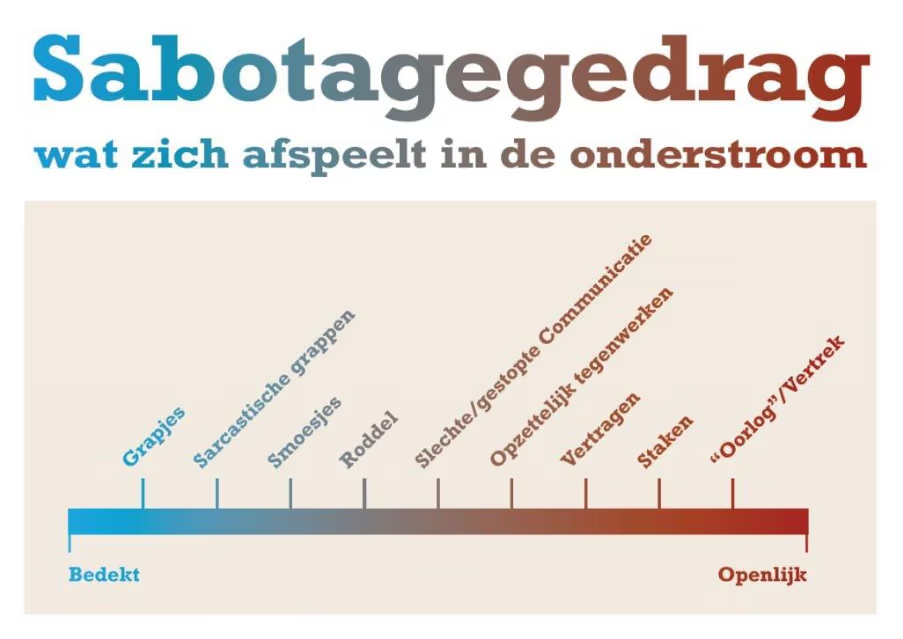
Resistance rarely arrives with a bang. It creeps in. Step by step. Here’s how to spot the buildup:
- Jokes
It starts innocently enough. Lighthearted. But as soon as the joke comes at someone’s expense, trust starts to fray.
“Maybe we shouldn’t invite Peter anymore, that way the meeting won’t run over.” (Laughter, awkward nodding from Peter.)
- Sarcasm
The tone turns cynical. The ‘target’ might still laugh along, but they haven’t felt safe for a long time.
“Great idea, another brainstorm. That really helped us out last time.”
- Excuses and stalling
“Too busy, we’ll get to it later.” “We’re not ready for that yet.” Sounds plausible, but the real issue remains unspoken.
- Gossip
The conversation shifts from talking with each other to talking about each other. The undercurrent grows, and the connection fades away.
“Did you hear how Anouk acted in that meeting yesterday? Ugh.”
- Poor or non-existent communication
Emails are still being sent, but the actual conversation is gone. Or things go quiet. Way too quiet.
An urgent question goes unanswered. Or you get: “See previous email.”
- Intentional obstruction
Information is withheld. Work is left undone or half-assed on purpose. Subtle sabotage.
A team member 'forgets' to share an important document until after the deadline.
- Stalling
Deadlines slip by. Discussions keep going in circles. Anything to block progress without having to say ‘no’.
“Let’s take another look at this. It still doesn’t feel quite right.” (For the sixth time.)
- Quitting
The team is checking out. Sometimes you hear it, sometimes they just vanish. They’ve hit the brakes.
A working group doesn’t show up for the scheduled review. No cancellation. No explanation.
- Escalation
People are leaving. Or they’re staying, but they’ve shut down. Whatever trust was there is gone. And when trust goes, change goes with it.
A colleague hands in their resignation. Another calls in sick ‘indefinitely.’
Seeing this kind of behavior in your team? It’s tempting to jump straight into action mode. But sometimes, you need to slow down, sync up, and figure out what’s really going on underneath.
I talked about this with Nadia, a psychologist for young people with eating disorders. Her work shows that resistance isn’t a roadblock—it’s data. Here are her lessons.”
Why is resistance a natural part of any change? And what is it telling you as a practitioner?
Nadia: “Resistance is just part of changing behavior. Nobody actually wants to change; everyone prefers the status quo. That’s not a disaster, it’s information: it shows you where the friction is. The core question isn’t “how do I push this away?”, but “how do I guide this so it can still lead to different behavior?”.

How do you get to the bottom of it so you can take targeted action within a team?
Nadia: ''I always start with a function/meaning analysis
- Pinpointing the behavior: what exactly do you see (procrastinating, making cynical jokes, staying away)?
- Trigger (context): when does it happen? Which situation, what time, which person?
- Short-term payoff: what does the resistance achieve? Think: feeling in control, having to do less, getting attention, lowering the tension.
- Choose & test a hypothesis: pick the most likely explanation (for example, a need for control) and adjust your approach accordingly. Does it work? Then you were on the right track. Doesn't it work? Adjust your hypothesis.''
What does someone get out of the resistance? That’s where your leverage is.
What do you do when resistance is mainly about control/clarity, without losing sight of the goal?
Nadia: ''Giving people control within boundaries often works. I set the goal (“we’re going to eat/we’re going to run this process”), but the kids choose the details: what order, what first bite, what food. Clarity upfront (like a schedule) lowers tension. On the back end, reinforce desired behavior: make it visible, give compliments, and let them make the next choice.''
When emotions run high in the team and the conversation stalls: how do you make it productive again?
Nadia: ''First, acknowledge the signal: “I can see this is frustrating/upsetting.” Only then adjust the pace and scope: take a short break, make the next step smaller, and bring back predictability (what, who, when).
I call that returning to the “window”, the window of tolerance: the workable zone where people can listen, think, and make decisions. If we shoot above it (too much emotion or too much being asked), learning and changing won't happen. If we’re below it (checking out), not much happens either. So: first get back into the window, with a break, a smaller step, and clarity, and only then push forward.''
How do you turn your change goal into their goal too? (WIIFM, “treasure” vs. “crocodile”)
Nadia: ''Start with the treasure: make it concrete what’s in it for them (less hassle, more autonomy, better results). If that’s not motivating enough, be clear about the crocodile (the real consequences of not changing).
Basically, you need to make sure it becomes their goal too, then they’ll get on board.
Practically: shrink the goal to something everyone finds achievable, make success visible quickly, and build up from there. And expect a short-lived spike in resistance before it drops: that’s normal.''

You can start with this tomorrow
What did I learn from Nadia? That resistance is always protecting something. And that you shouldn't just look at what someone isn't doing, but also at what that behavior is doing for them. Once you know that, you can tailor your approach. Below are five lessons that help me (and hopefully you too) push less and understand more:
1. Ask yourself: what is this behavior actually achieving? Is it about control, clarity, safety, attention, or peace of mind? What’s really going on underneath?
2. Provide control within clear boundaries. Not everything needs to be wide open. But if you set the goal, give them some room on the "how." For example, let teams choose between two viable routes instead of forcing them down one specific path.
3. Keep people within their "window". Spotting signs of disengagement or escalation? Take a break, break the task down, or clarify the situation. Get them back in the window first, then move forward.
4. Make it their goal too: Use the WIIFMquestion: What’s in it for them?
5. Use the treasure and the crocodile. What does the change bring (the treasure)? And what happens if you do nothing (the crocodile)? Not as a threat, but as a realistic perspective.
In my next blog, I’ll be talking about "The danger of staying silent."


Frequently asked questions
Start by slowing down to analyze the behavior: what are you seeing, what’s the context, and what’s the outcome? Only then should you tailor your approach to the underlying need, whether that’s clarity, autonomy, or a sense of safety.
You can spot resistance through behaviors like cynicism, making excuses, procrastination, gossiping, or just clamming up. The sabotage scale helps you track these signs step by step—from harmless jokes all the way to full-blown escalation.
Resistance shows you exactly where the friction lies between your plans and your company culture. It’s a goldmine for uncovering hidden beliefs, fears, or needs, and it’s the best compass for making sure change actually sticks.
Resistance is a natural reaction to change, where people act in ways that slow things down or bring progress to a halt. It’s not a problem to be fixed, but rather a goldmine of insight into what’s really going on beneath the surface of your team or organization.
Resistance usually pops up because of uncertainty, a lack of control, fuzzy communication, or when a change just doesn't vibe with the company culture.


















.avif)











Fancy a chat?
Do you have a data, cloud or IT transformation challenge? We are happy to think along with you. Feel free to contact us.