
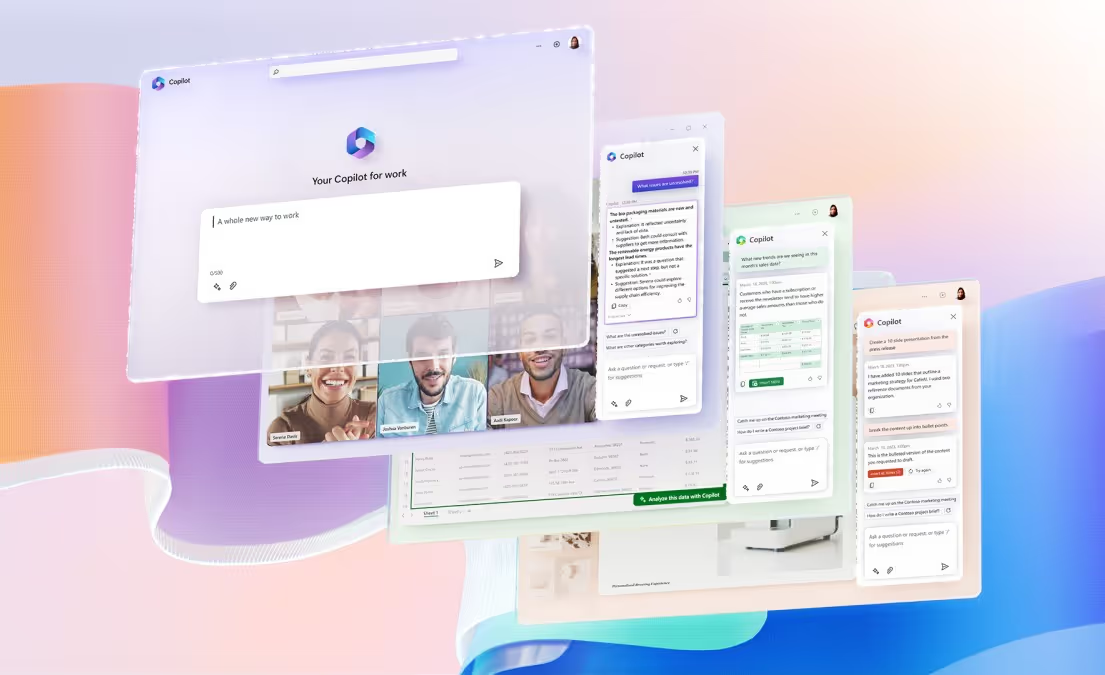
Microsoft 365 Copilot has been given the green light. Great. But now the real work begins.


Over the past few months, I’ve had plenty of conversations with clients about AI. I’ve talked to IT managers, CISOs, security officers, privacy officers, and executives. And almost every single time, the conversation hits the exact same point.
“Anton, honestly… we want to do this. But are we actually allowed to use it?”
I totally get that question. Because AI has been a mix of huge promises, impressive demos, legal uncertainty, and executive jitters for many organizations over the last two years. Everyone sees the potential. But nobody wants to be the one who rolls out a technology across the board only to have to explain later why data, compliance, or security weren't properly under control.
That’s why the recent DPIA update regarding Microsoft 365 Copilot is so relevant. The reassessment by SLM and SURF shows that responsible use of Copilot remains possible within government and education, provided that organizations handle the remaining risks with care and weigh their use cases properly. The previously identified high privacy risks have largely been reduced or mitigated. At the same time, there are still points of attention, including the accuracy of output and the retention period for diagnostic data.
And honestly? I think this is a major turning point. Not because everything is suddenly safe—that would be too easy. But because for many organizations, this is the moment where Microsoft 365 Copilot becomes much easier to justify at the executive level.
The question is shifting from “are we allowed to use this?” to “under what conditions can we deploy this safely, accountably, and manageably?”
The market wasn't afraid of AI
I rarely see real resistance from clients regarding what AI can actually do. People definitely get the value. They see that Copilot can help with summarizing documents, prepping for meetings, structuring information, drafting text, analyzing data faster, and cutting down on repetitive tasks.
The market wasn't afraid of AI. The market was afraid of the consequences.
That distinction is important. Because as soon as AI is linked to SharePoint, Teams, OneDrive, Exchange, and other parts of Microsoft 365, it’s no longer just about productivity or innovation. Suddenly, it’s about information management, governance, permission structures, compliance, data ownership, and accountability. And that is exactly where the real work begins for IT, security, and compliance.
Microsoft 365 Copilot isn't just some standalone AI tool you use alongside your existing environment. Copilot works based on the information already present in your Microsoft 365 tenant. Anything users are currently allowed to find, Copilot can now surface faster, smarter, and with more context. That makes the value huge, but it makes your reliance on your existing setup even bigger.
Copilot doesn't cause the problem. Copilot makes it visible.
That might be the most important observation we see with our clients. Many organizations secretly hope that AI will be some kind of digital assistant that cleans up the chaos. But AI acts more like a magnifying glass.
A poor permission structure becomes more visible. Outdated documentation suddenly pops up in summaries. Sensitive information in illogical places is found faster. Unclear data ownership turns from a management headache into a business risk. Old Teams sites, orphaned SharePoint environments, and inconsistent classification were already problems before Copilot, but the impact was often limited because users had to actively go looking for them.
Copilot changes all that. Information can be combined, summarized, and presented in the context of a specific question much faster. This bridges the gap between the user and sensitive information.
For IT managers, CISOs, and security officers, that’s the bottom line. Implementing Copilot isn't just a standard adoption project or a license rollout. It’s a governance issue. For compliance, it’s a matter of accountability. For leadership, it’s a risk management issue. And for the business, it’s a productivity play. All these perspectives need to be aligned from the start.
Getting the green light doesn't mean just flipping the switch
I’m also seeing another risk emerge. Namely, that organizations are now thinking: “Great, the DPIA is sorted. We’re good to go.” But that would be a mistake.
The DPIA update gives you the green light, but it doesn't take the responsibility off your plate. Responsible AI use doesn't just happen because the technology is available. It requires policy, leadership, clear frameworks, technical setup, adoption, training, and sometimes just making some grown-up decisions.
Because yes, AI is going to make mistakes. And yes, employees are going to use AI the wrong way sometimes. That doesn't mean you should block AI. It means you need to organize your responsibility.
It starts with some concrete questions:
- Which processes are suitable for Copilot?
- What data is allowed to be used?
- Which groups should start first?
- Which risks are we willing to accept and which aren't we?
- How do users verify the output?
- What kind of logging is required?
- How transparent are we being with our employees?
- Who owns the policy, management, and monitoring?
- And how do we demonstrate that we’re acting responsibly?
These aren't details to worry about later. These are the prerequisites for getting started safely.
Why this is especially relevant for government and education
This development is especially critical for government and education. These organizations handle public responsibilities, sensitive personal data, policy information, research data, student records, case files, and administrative decision-making. At the same time, there is immense pressure to work smarter, faster, and more efficiently.
Copilot can provide significant value here. Think of policy preparation, knowledge sharing, document analysis, curriculum development, service desk processes, internal communications, and management support. But that value only materializes when it’s clear what information is available, who has access, what frameworks apply, and how oversight is structured.
In these sectors, AI needs to be more than just handy. It must also be explainable, auditable, and proportional.
But let’s be real: this doesn't just apply to government and education. Any organization serious about using Copilot needs to know what the AI assistant can see and the risks that entails. The technical configuration of Microsoft 365 is becoming more strategic than ever.
Why I believe in the Microsoft ecosystem
This is also why I believe in the Microsoft ecosystem. Not because Microsoft is always perfect—that would be nonsense. But because Microsoft is one of the few players trying to combine AI with governance, security, compliance, and enterprise integration.
And that is ultimately what large organizations are judged on. Not on the flashiest demo, but on manageability, continuity, explainability, and risk mitigation.
Most organizations don't want to manage twenty separate AI tools. They want a platform that fits into their existing way of working, their identity structure, their security policies, and their compliance obligations. That’s exactly why Copilot is interesting—but only if the underlying Microsoft 365 environment is ready for it.
Because if your governance isn't in order, you aren't automating maturity. You’re scaling vulnerability.
The winners aren't the ones who turn AI on the fastest
I believe AI is fundamentally changing the way we work. In fact, it’s already happening. But the organizations that get the most out of this aren't necessarily the ones that roll out Copilot to everyone the fastest.
The winners are organizations that know how to combine innovation with trust. Organizations that understand their Microsoft 365 environment, take governance seriously, bring their employees along, and have the courage to integrate AI into their processes in a controlled way.
That’s why this Microsoft update feels more important to me than "just another AI announcement." This isn't just about technology. It’s about how you, as an organization, continue to build responsibly in an era where AI is becoming part of everything.
Microsoft 365 Copilot is gaining ground. That’s great. But now the real work begins. Not by simply flipping the switch on Copilot, but by taking control: with insight into your data, clear frameworks, secure configuration, and a focus on adoption.
Want to explore what this means for your organization? Download our AI playing field on the website. It will help you get a clear picture of where you stand, what choices you need to make, and how to deploy AI responsibly.
Want to brainstorm further about a safe and manageable start with Copilot? Then get in touch get in touch. I’d love to help you brainstorm.


Frequently asked questions
.avif)






























Fancy a chat?
Do you have a data, cloud or IT transformation challenge? We are happy to think along with you. Feel free to contact us.